


We frequently talk about the connection between earned media and AEO visibility. We’ve blogged about the growing importance of AEO in your PR strategy. But there is something different about watching it happen to your own agency in real time.
Recently we had one of those moments.
In May, our PR team announced Moburst’s $11.8 million investment from Chrysalis Holdings. The coverage came quickly, including AdWeek, Business Insider, PR Week, Net Influencer, and O’Dwyer’s. Good placements, the kind of outlets that matter in our industry. We were proud of the coverage and moved on to the next thing, the way you do.
Then the AEO data came in.
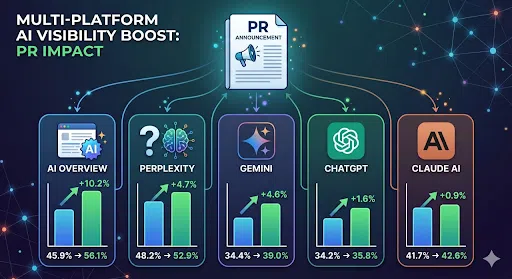
Our overall brand share of voice jumped from 39.2% to 43.9% in a single week. That’s a 4.7 point gain across roughly 750 tracked queries on five platforms simultaneously, and our team flagged it immediately as the strongest weekly gain we had recorded in recent cycles. But the number that genuinely stopped us was this one: in the PR Agency category specifically, our visibility across all large language models jumped from 51.9% to 69.4%. A 17.5 point swing. In seven days. Tied directly to one round of earned media coverage.
AI Overview moved 10.2 points. Perplexity moved 4.7. Gemini moved 4.6. Even on platforms where movement tends to be slower, there were meaningful gains. Our confidence level in cause and effect – meaning we are confident this was due to the coverage and not an algorithm change or an external variable – came in at 98.6%.
We checked for algorithm updates. Google I/O took place during the same window, but the announcements focused on AIO expansion features, not ranking changes. There was nothing else that explained the movement. It was the press coverage. That was it.
We have been making the argument to clients for some time now that the relationship between earned media and AI visibility is real, measurable, and faster-moving than most people expect. We have the client data to support it. But there is something about watching your own agency’s numbers move like this, in your own category, from your own announcement, that makes the argument land differently.
This is what PR looks like right now. It is not just about who reads the story the week it runs, it’s about what the AI platforms ingest, cite, and surface for months afterward. Every placement is training data. Every credible mention in a high-authority outlet is a signal that the answer engines use to decide whether your brand belongs in the conversation.
One announcement. Five placements. A 17.5 point visibility jump in seven days.
On Speed and Cause and Effect
The most counterintuitive lesson from this data is how fast it happened. Most executives think of PR as a slow-burn investment – something that builds over months and years – and that’s not wrong. But this week showed that in the world of LLMs, a single well-placed announcement in the right outlets can move measurable needles quickly. The question for CEOs and CMOs is not whether PR produces results, but whether you can afford to keep waiting to start.
The Multiplier Effect
One announcement generated five placements. Five placements generated movement across five AI platforms simultaneously. That is not a linear return; it’s a multiplier. Each placement didn’t just reach the readers of that publication. It became a signal that fed into the AI infrastructure that an increasing number of buyers, investors, and partners are using every day to form opinions about who matters in your category. The traditional way of measuring PR dramatically understates what is actually happening.
Every single point of AI visibility movement in this data came from earned media, and not paid advertising, sponsored content, or a boosted post. The AI platforms cited AdWeek, Business Insider and PR Week because those outlets independently decided the story was worth covering. The fact that a real journalist at a real publication deemed this newsworthy is what gives the coverage its weight with the algorithms and the humans reading the answers those algorithms produce. Paid media cannot replicate that signal no matter how large the budget.
On What This Means for Competitive Positioning
Every week that competitor generates coverage and you don’t, they’re building AI visibility and you aren’t. The answer engines are forming a picture of who the credible players are in your category in real time, based on who shows up in the sources they trust. That picture is not neutral – it favors the companies that are consistently present in earned media. The companies that are not investing in PR are falling behind in a race they may not even know they’re running.
Let's Talk
Let’s get your brand the attention it deserves.
"*" indicates required fields