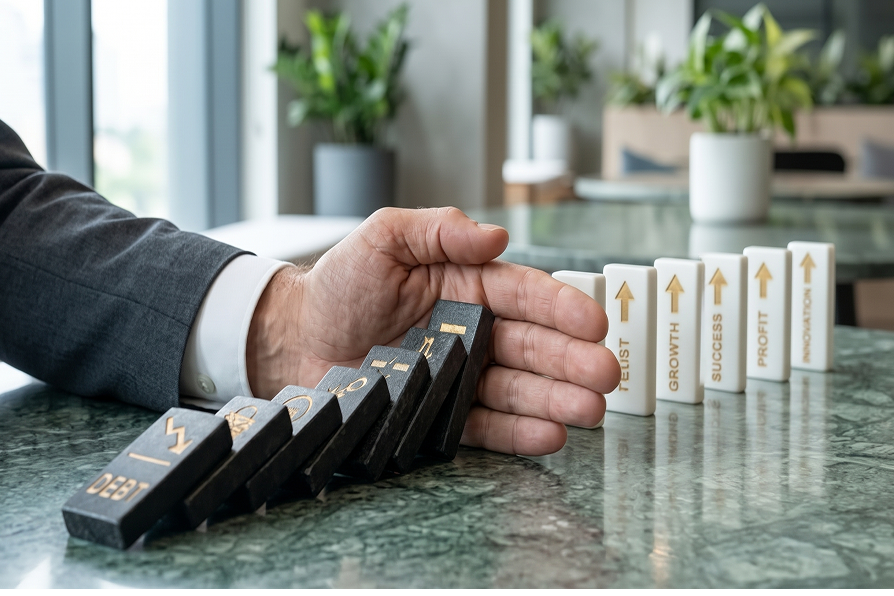



Three forces are pushing communications onto the board agenda. AI systems are now deciding how your company gets described to buyers and investors. Reputation risk moves faster and costs more than it did five years ago. And category positioning has become something investors and acquirers price directly into valuation. None of those are marketing problems. They are governance problems, and the person who has to answer for them is you.
Here is what your board is going to ask, and what a good answer sounds like.
How Does AI Describe Our Company?
This is the question that catches CEOs off guard, because a year ago nobody was asking it.
Directors are hearing about it from portfolio companies and from their own experience. A board member types your category into ChatGPT or Perplexity before a meeting, sees three competitors named and not you, and arrives with a pointed question. That happens more often than most leadership teams realize.
Answer Engine Optimization, or AEO, is the practice of making sure the authority your brand builds through earned media actually shows up when someone asks an AI about your category. It matters at the board level for a simple reason. AI systems cite what they trust, and what they trust is largely the same set of authoritative outlets that PR teams have been pitching for decades. Your earned media footprint is now the raw material for how AI describes you to anyone doing research on your company.
We watched this happen to our own agency. In May, we announced Moburst’s $11.8 million investment from Chrysalis Holdings, and the coverage landed across AdWeek, Business Insider, PR Week, Net Influencer, and O’Dwyer’s. Within seven days, our visibility in the PR Agency category across large language models moved from 51.9% to 69.4%. That is a 17.5-point swing tied to one round of earned media, tracked across roughly 750 queries on five platforms. We checked for algorithm updates and found nothing that explained it. It was the coverage.
The board-ready version of that answer is not “we are working on AI.” It is a baseline measurement of how you currently show up, which of your placements AI systems are actually citing, and what the trend line looks like quarter over quarter. We broke down the full data set in the week our own PR moved our AI visibility 17.5 points, and the underlying case in why answer engine optimization now sits on top of earned media.
What Is Our Actual Exposure If This Goes Wrong?
Boards think in downside scenarios. That is the job. So the second question is about risk, and it is usually phrased more bluntly than the first.
Most companies cannot answer it well, because their crisis plan is a document nobody has read since onboarding. The honest board answer covers four things. Who speaks for the company when something breaks. What the escalation path looks like and how fast it runs. Which vulnerabilities leadership already knows about. And whether the people who would handle a crisis have relationships with the reporters who would cover it.
That last piece is the one boards underestimate. When a story is developing, the difference between a reporter calling you for context and a reporter publishing without you is almost always a relationship that existed beforehand. You cannot build it during the crisis.
More on that in the hidden cost of a story that goes sideways.
Is Our Category Position Actually Defensible?
The third question is the most strategic one, and it is where PR stops looking like a marketing line item.
When a board evaluates category leadership, they are not asking about clip volume. They are asking whether an outside party would independently describe your company as a leader. That distinction matters enormously in fundraising, partnership talks, and diligence.
Consider who reads your coverage besides customers:
| Reader | What they take from your media presence |
|---|---|
| Industry analysts | Whether you belong in the framework buyers use |
| Investors | Whether the market is paying attention before you pitch |
| Strategic partners | Whether you are a known quantity or a risk |
| Acquirers | Whether diligence will be smooth or full of surprises |
None of those people fill out a contact form. All of them affect enterprise value. A board that understands this stops treating communications as a cost center and starts treating it as an input to valuation.
The practical test is consistency. Sophisticated readers are not weighing any single placement. They are watching whether your company shows up when the category comes up, and not only when you have something of your own to announce. A company that appears twice a year, both times tied to its own news, reads very differently than one whose executives are in the conversation every month. We went deeper on this in the analyst and investor audience most PR strategies ignore.
We saw the value of the right audience with our client NewDay USA, a mortgage lender serving veterans. We placed them in a Military.com feature on housing affordability for service members and veterans. The outlet was not the largest one available. It was the right one, reaching exactly the audience that matters to that business, and the lead flow correlated with publication almost immediately. That is the kind of specificity a board can act on, and it is the same tracking approach we walk through in how we show a CEO that PR is working.
Getting Ahead of the Conversation
The CEOs who handle these questions well are not the ones with the most impressive coverage. They are the ones who brought the questions to the board before the board brought them to the table.
That means walking in with three things. A measured read on how AI systems currently describe your company and where the gaps are. A crisis posture that names people, timelines, and known vulnerabilities rather than describing a process. And a category positioning story that an outside analyst could repeat in their own words, supported by a coverage record that holds up under scrutiny.
None of that requires a bigger budget. It requires a communications program built around business outcomes from the start, and a partner who understands that the audience for your coverage now includes your board, your investors, and the AI systems your buyers are asking about you. If you want to pressure-test whether your current program can survive that conversation, contact us.
Let's Talk
Let’s get your brand the attention it deserves.
"*" indicates required fields